 by
by Introduction
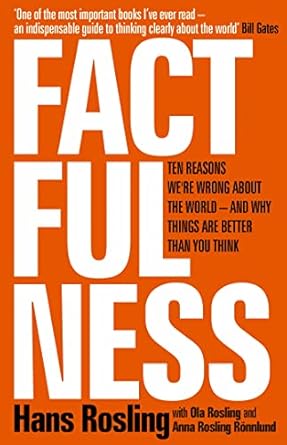
In a world overflowing with headlines of crisis, fear, and division, one book stands tall as a beacon of hope and clarity — “Factfulness: Ten Reasons We’re Wrong About the World—and Why Things Are Better Than You Think” by Hans Rosling.
If you’ve ever found yourself feeling that the world is falling apart, or that poverty, disease, and inequality are worse than ever — this book will surprise you, enlighten you, and quite possibly change the way you think forever.
👉 Get your copy of Factfulness by Hans Rosling here: https://amzn.to/4ndAEw8
What is Factfulness About?
At its heart, Factfulness is about seeing the world based on facts rather than fear. Hans Rosling — a physician, global health expert, and TED speaker — along with his co-authors Ola Rosling and Anna Rosling Rönnlund, shatters the myths that shape our worldview.
Most people, including highly educated professionals, believe the world is getting worse. But as Rosling shows with hard data and engaging visuals, the world is actually improving in many ways — from declining child mortality to rising literacy rates and expanding access to clean water.
He calls this gap between perception and reality the “Factfulness gap.”
In simple terms, the book challenges the negativity instinct — the tendency to assume things are bad and getting worse. Factfulness helps us look beyond emotional headlines and see how far humanity has actually come.
Why the World Isn’t as Bad as You Think
Hans Rosling begins with a simple yet profound message: “Things can be bad, and getting better at the same time.”
That’s the essence of Factfulness. We’re not denying problems — we’re understanding progress with perspective.
For instance:
- Extreme poverty has been cut in half in the last 20 years.
- Child mortality rates have dropped dramatically.
- Life expectancy has increased globally.
- Education access is rising faster than ever.
But why don’t we see this progress?
Because our brains are wired to focus on the negative. News outlets thrive on drama, schools rarely update global data, and we often use outdated mental models to interpret the modern world.
Factfulness teaches readers to retrain their instincts, to question generalizations, and to seek data-driven understanding instead of emotional assumptions.
The Ten Instincts That Distort Our View
Hans Rosling identifies ten key instincts that make us view the world incorrectly. These instincts are the backbone of the book — and learning to recognize them can completely change how you interpret information.
Let’s explore each briefly:
1. The Gap Instinct
We often divide things into two groups — rich vs. poor, developed vs. developing — and overlook the massive middle. Rosling shows that most people now live in middle-income countries, not extreme poverty or wealth.
2. The Negativity Instinct
We notice bad news more than good. But statistically, almost every indicator of human well-being has improved over the past decades.
3. The Straight Line Instinct
We assume trends continue in a straight line. Rosling warns that population growth will stabilize as education and health improve, not skyrocket endlessly.
4. The Fear Instinct
Fear sells — from terrorism to pandemics. But Rosling reminds us to look at data. For example, far fewer people die in plane crashes or natural disasters today than in the past.
5. The Size Instinct
We tend to overestimate large numbers. Factfulness teaches us to compare and put data in context — one of Rosling’s most powerful lessons.
6. The Generalization Instinct
We lump groups together. Instead, we should look for differences within categories — not just between them.
7. The Destiny Instinct
We believe cultures or nations are unchanging. Rosling’s data proves how fast societies evolve when given opportunities.
8. The Single Perspective Instinct
We love simple explanations, but real understanding comes from multiple perspectives — economic, social, medical, and environmental.
9. The Blame Instinct
We want to find someone or something to blame. Factfulness encourages us to look for causes, not villains.
10. The Urgency Instinct
We often feel we must act now — but that leads to rash decisions. Taking a breath, analyzing data, and understanding trends leads to better decisions.
Each instinct is illustrated with real-world examples, statistics, and Rosling’s signature humor and humility.
👉 You can dive deep into these life-changing lessons by getting the book here: https://amzn.to/4ndAEw8
Hans Rosling’s Unique Storytelling Style
What makes Factfulness truly special isn’t just the data — it’s how Hans Rosling tells the story.
He transforms global statistics into engaging narratives and relatable human stories. Whether he’s talking about a hospital patient in Mozambique or presenting data with colorful bubbles on a screen, Rosling connects numbers to real lives.
His passion is infectious. He doesn’t lecture — he invites you to think.
In every chapter, you feel like you’re sitting in one of his famous TED Talks, watching a master communicator make complex data feel simple, emotional, and empowering.
It’s no surprise that Bill Gates once said, “One of the most important books I’ve ever read—an indispensable guide to thinking clearly about the world.”
Why You Should Read Factfulness in 2025
In today’s digital era, misinformation spreads faster than truth. Social media amplifies fear, exaggeration, and outrage.
That’s why Factfulness is more relevant than ever.
The book teaches critical thinking — not through abstract theory, but through practical mental tools. It helps you:
- Evaluate news headlines more rationally.
- Understand global issues like climate change, poverty, and inequality more accurately.
- Communicate facts with confidence, not emotion.
- Stay calm and hopeful in a chaotic world.
If you’re tired of feeling overwhelmed by bad news or frustrated by misinformation, this book is your antidote to anxiety.
The Data Revolution: A New Way to See the World
Hans Rosling doesn’t ask you to ignore your emotions — he asks you to balance them with facts.
His data-driven optimism gives readers a refreshing perspective: humanity is not doomed; it’s progressing.
Using decades of United Nations and World Bank data, Rosling proves that:
- Global literacy has risen from 20% to over 85%.
- Vaccination rates have skyrocketed.
- Life expectancy has improved by more than 30 years since 1800.
- Fewer people live in extreme poverty today than at any point in recorded history.
This isn’t blind optimism — it’s factful optimism.
As Rosling beautifully puts it:
“When we have a fact-based worldview, we can see that the world is not as bad as it seems, and we can focus on continuing to make it better.”
Factfulness and Business Decision-Making
Interestingly, Factfulness isn’t just for data lovers or humanitarian workers — it’s a powerful guide for business leaders, investors, and policymakers.
Understanding the real trends helps:
- Identify emerging markets (many developing nations are now middle-income).
- Avoid biases in strategic planning.
- Make rational investment decisions based on data, not fear.
- Build communication strategies rooted in real progress stories.
For entrepreneurs and investors, Factfulness offers a more accurate global picture — helping you spot growth where others see risk.
👉 For anyone in business or management, this book is a must-read: https://amzn.to/4ndAEw8
Lessons from Factfulness You Can Apply Today
Here are some practical takeaways from Rosling’s book that can change how you think and act:
- Update Your Worldview Regularly
Just like software, your understanding of the world needs updating. Use reliable data sources like Gapminder (founded by Rosling) or UN statistics. - Embrace Fact-Based Optimism
A realistic yet hopeful outlook helps you stay motivated and informed. The world’s progress is proof that change is possible. - Question Dramatic Stories
When a headline feels extreme, check the data before reacting. Often, the truth is more balanced. - Focus on Trends, Not Headlines
News focuses on events; progress happens gradually. Looking at long-term trends gives you perspective. - Teach Others Factfulness
Encourage children, students, and colleagues to see the world through facts — not fear.
The Legacy of Hans Rosling
Hans Rosling passed away in 2017, but his vision lives on through Factfulness and his foundation, Gapminder.
He spent his life teaching people to look at data not as cold numbers, but as stories of human progress.
He once said:
“The world cannot be understood without numbers. But the world cannot be understood with numbers alone.”
This balance between facts and humanity is what makes Factfulness timeless.
Who Should Read Factfulness?
This book is for everyone who wants to understand the world better — whether you’re:
- A student trying to see beyond textbooks
- A professional making data-driven decisions
- A parent teaching your kids optimism and perspective
- A journalist, educator, or policy-maker who influences public understanding
- Or simply a curious reader tired of negativity and misinformation
If you want to replace worry with wisdom, and confusion with clarity — Factfulness is your roadmap.
Factfulness Book Review: Why Readers Love It
Readers around the world have called Factfulness:
- “Eye-opening and empowering.”
- “A cure for global pessimism.”
- “The book that changed how I see everything.”
On Goodreads and Amazon, it has thousands of 5-star reviews for a reason. People don’t just read it — they feel transformed by it.
👉 You can read it yourself here: https://amzn.to/4ndAEw8
Final Thoughts: Choose Factfulness Over Fear
At a time when fear dominates headlines and outrage fills social media, Factfulness reminds us to pause, look at the data, and think clearly.
Hans Rosling doesn’t claim the world is perfect — he reminds us it’s improving.
He empowers us to move beyond hopelessness, replacing despair with understanding.
If you crave clarity in a confusing world, this book will be one of the best investments you’ll ever make.
📘 Grab your copy of “Factfulness – Hans Rosling” here and start seeing the world as it truly is:
👉 https://amzn.to/4ndAEw8
Must-Read Book Summaries You’ll Love
If leadership, mindset, influence, and personal growth fascinate you, don’t stop here. These hand-picked book summaries from our blog dive deeper into psychology, success, motivation, power, and timeless wisdom—each packed with practical takeaways you can use immediately:
Discover the psychology behind why people say “yes” and how ethical persuasion can transform leadership and decision-making.
Learn the life-changing power of seeing the world as it truly is, backed by data, logic, and optimism that reshapes how leaders think.
A deep dive into Daniel H. Pink’s revolutionary ideas on motivation—and why autonomy, mastery, and purpose matter more than rewards.
Explore how vulnerability becomes strength, helping leaders build trust, courage, and wholehearted living in both work and life.
A timeless guide to living in the present moment, reducing stress, and unlocking inner clarity—essential for mindful leadership.
An inside look at the mind of a visionary who is reshaping the future through relentless ambition, innovation, and risk-taking.
A bold exploration of power, politics, and leadership realities, offering lessons that remain surprisingly relevant today.
Master timeless strategies for winning—not just in war, but in business, leadership, and everyday challenges.
Uncover the money lessons schools never taught you, and reshape how you think about wealth, assets, and financial freedom.
The 7 Habits of Highly Effective People by Stephen R. Covey
A classic blueprint for personal effectiveness, leadership excellence, and long-term success that never goes out of style.
- Why Explore These Book Summaries?
- ✔ Quick insights from bestselling books
- ✔ Practical lessons for leadership & growth
- ✔ Easy-to-read, human-written summaries
- ✔ Perfect for lifelong learners & leaders
👉 Bookmark these reads and keep sharpening your leadership edge.
“Start Your Website Journey Today – Exclusive Hostinger Discounts!”

Turn Any Idea into Viral,
Jaw-Dropping AI Videos in Seconds!