 by
by Have you ever wondered why some people always get a better deal, whether they’re negotiating a salary, closing a business deal, or simply convincing someone to agree with them? What if you could learn their secrets—directly from an FBI hostage negotiator who handled life-and-death situations?
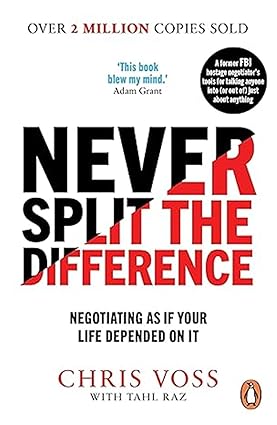
That’s exactly what Never Split the Difference by Christopher Voss & Tahl Raz delivers. This isn’t just another business book—it’s a negotiation masterclass, teaching techniques that truly work in real-world conversations, tough situations, and high-pressure decision-making.
And if you want to get your own copy, you can grab it here: 👉 https://amzn.to/3MJAvUA
In this in-depth review, we break down the core ideas, life lessons, and practical negotiation strategies from the book—written in a conversational, human-friendly style that any beginner or professional can understand.
Let’s dive in.
⭐ Why This Book Still Dominates Negotiation & Psychology Shelves
Most negotiation advice tells you:
- Stay calm
- Be logical
- Make compromises
- Meet halfway
But Chris Voss argues the opposite.
As a former FBI lead international hostage negotiator, he learned one lesson again and again:
“Compromise is often the worst deal you can make.”
If a hostage taker wants $1 million and you offer $500,000—that isn’t smart negotiation. It’s failure.
And the same applies in business and everyday life.
Instead, Voss introduces a new approach based on human psychology, tactical empathy, and strategic communication techniques that influence decisions.
This fresh perspective is what makes Never Split the Difference stand out even today.
🔥 Key Lessons & Strategies from “Never Split the Difference”
Below are the most powerful negotiation techniques the book teaches—explained simply, with examples you can apply today.
Use them in your relationships, workplace, business deals, or even friendly conversations.
1️⃣ Tactical Empathy – Understanding Emotions, Not Overpowering Them
Empathy is NOT agreeing.
Empathy is NOT surrendering.
It’s simply understanding what the other person feels and acknowledging it out loud.
Voss calls it tactical empathy.
For example:
- “It sounds like you’re frustrated.”
- “It seems you feel this isn’t fair.”
- “It looks like this is stressing you out.”
These simple statements instantly lower defenses.
Why?
Because people are wired to feel safe when they are understood.
Tactical empathy is one of the strongest tools in negotiations, and the book shows exactly how to use it.
2️⃣ The Magic of “Mirroring” – The FBI Secret Weapon
Mirroring is repeating the last 1–3 words someone says.
For example:
Client: We need more time to finalize the budget.
You: Finalize the budget?
This tiny technique triggers them to reveal more information—without feeling interrogated.
Voss used this on dangerous criminals.
You can use it to:
- Understand a colleague’s real concern
- Get a client to reveal true objections
- Calm a tense conversation
- Keep someone talking until you find the real issue
Mirroring works because humans instinctively open up when someone reflects their words.
3️⃣ Labeling Emotions – Name It to Tame It
Labeling is identifying the emotion behind someone’s words.
Example:
- “It seems like this decision makes you nervous.”
- “It sounds like you’re concerned about the deadline.”
Once the emotion is named, the tension dissolves.
This is one of the book’s most powerful strategies—and incredibly simple.
4️⃣ The Power of “No” – Letting People Feel in Control
Most of us chase a yes during negotiations.
But Voss says:
Stop chasing “yes.” Start getting “no.”
Why?
Because when people say no, they feel:
- Safe
- In control
- Not threatened
This emotional comfort opens the door to real conversation.
Here’s an example:
Instead of asking:
“Is now a good time to talk?”
Try:
“Is now a bad time to talk?”
This counterintuitive trick increases cooperation because it respects boundaries.
5️⃣ Calibrated Questions – The Genius of Asking the Right “How” & “What”
Calibrated questions begin with “How” or “What,” and they force the other person to think and solve the problem with you.
Examples:
- “How can we make this work for both of us?”
- “What’s the biggest challenge you’re facing right now?”
- “How am I supposed to do that?” (one of Voss’s favorites!)
These questions make the counterpart feel involved, respected, and responsible for finding a solution.
6️⃣ “The Ackerman Model” – Negotiation Strategy That Wins Deals
This is Voss’s famous bargaining method:
- Set your target price.
- Offer 65% of that number.
- Increase to 85%.
- Then 95%.
- End at 100%, but with calibrated questions and empathy.
It works because it feels natural, measured, and psychologically comfortable for the other party.
This model alone is worth the price of the book.
7️⃣ Using Deadlines for Negotiation Advantage
People make emotionally driven decisions when deadlines loom.
Voss explains how to use (or not fall for) artificial deadlines.
This insight is crucial for:
- Salary negotiations
- Business deals
- Sales closures
- Real estate offers
Understanding the psychology of urgency helps you stay calm while others feel pressured.
8️⃣ Beware of “Fair” – The Most Manipulative Word in Negotiations
People often use “fair” to make you feel guilty or pressured.
Example:
- “I just want what’s fair.”
- “Does that sound fair to you?”
- “We’re not being treated fairly.”
The book teaches you how to identify and disarm this emotional tactic—without getting blindsided.
🎯 Why This Book Is a Must-Read for Everyone
You don’t have to be a negotiator to benefit from this book.
These tools help in:
✔ Business negotiations
✔ Salary hikes
✔ Buying or selling anything
✔ Handling conflicts
✔ Parenting
✔ Marriage and relationships
✔ Leadership roles
✔ Customer interactions
The book shows that every conversation is a negotiation, and those who master these skills simply perform better in life.
📘 About the Authors – Christopher Voss & Tahl Raz
Christopher Voss
- Former FBI chief hostage negotiator
- Founder of The Black Swan Group
- Teaches negotiation to top CEOs, business schools & government agencies
Tahl Raz
- Bestselling author
- Expert in journalism & storytelling
- Co-author of several business classics
Their combination—real FBI experience + powerful storytelling—creates a book that’s thrilling, practical, and unforgettable.
🧠 Real-Life Examples That Make the Book Unputdownable
The book is filled with stories like:
- Negotiating with terrorists
- Talking down armed bank robbers
- Saving hostages overseas
- Getting companies out of multimillion-dollar crises
These dramatic real-life scenarios make the techniques memorable and enjoyable to read.
📈 How This Book Improves Your Communication Skills
By applying the techniques from Never Split the Difference, you’ll notice improvements like:
- Better emotional intelligence
- Clear, confident responses
- Increased respect from others
- More productive conversations
- Stronger relationships
- Higher success rate in deals
This makes it one of the best negotiation books ever written.
💡 Final Thoughts: Should You Read “Never Split the Difference”?
Absolutely yes.
This book is essential reading for:
- Entrepreneurs
- Employees
- Leaders
- Sales professionals
- Students
- Anyone who wants better control over conversations
The strategies are simple, deeply psychological, and proven to work—even in the tensest situations.
If it can work with terrorists, it can work anywhere.
📌 Want to read it yourself? Grab the book here:
Must-Read Book Summaries You’ll Love
If leadership, mindset, influence, and personal growth fascinate you, don’t stop here. These hand-picked book summaries from our blog dive deeper into psychology, success, motivation, power, and timeless wisdom—each packed with practical takeaways you can use immediately:
Discover the psychology behind why people say “yes” and how ethical persuasion can transform leadership and decision-making.
Learn the life-changing power of seeing the world as it truly is, backed by data, logic, and optimism that reshapes how leaders think.
A deep dive into Daniel H. Pink’s revolutionary ideas on motivation—and why autonomy, mastery, and purpose matter more than rewards.
Explore how vulnerability becomes strength, helping leaders build trust, courage, and wholehearted living in both work and life.
A timeless guide to living in the present moment, reducing stress, and unlocking inner clarity—essential for mindful leadership.
An inside look at the mind of a visionary who is reshaping the future through relentless ambition, innovation, and risk-taking.
A bold exploration of power, politics, and leadership realities, offering lessons that remain surprisingly relevant today.
Master timeless strategies for winning—not just in war, but in business, leadership, and everyday challenges.
Uncover the money lessons schools never taught you, and reshape how you think about wealth, assets, and financial freedom.
The 7 Habits of Highly Effective People by Stephen R. Covey
A classic blueprint for personal effectiveness, leadership excellence, and long-term success that never goes out of style.
- Why Explore These Book Summaries?
- ✔ Quick insights from bestselling books
- ✔ Practical lessons for leadership & growth
- ✔ Easy-to-read, human-written summaries
- ✔ Perfect for lifelong learners & leaders
👉 Bookmark these reads and keep sharpening your leadership edge.
“Start Your Website Journey Today – Exclusive Hostinger Discounts!”

Turn Any Idea into Viral,
Jaw-Dropping AI Videos in Seconds!